Monday, February 25, 2013

MODERN CHANGE AGENTS –ENEMIES OF MANKIND !!!?? THIS POST IS ABOUT LIVESTOCK.


“Little is written about William Carey and his contribution to Indian agriculture and horticulture” .This is the sentiment of the architects of  William Carey University, Meghalaya and is expressed in their web page titled Our Vision , where they acknowledge the ‘numerous contributions’ of William Carey .(www.wcu.co.in/Vision.htm).

Rev. Dr. William Carey’s contribution towards Modernising Indian Agriculture and Horticultre will have to be ‘duly acknowledged’ and then critically examined.  His thoughts and ideas  forms the basis of modern Indian Agricultural Universities and Vet nary Colleges. And if such ideas are allowed to continue and have a free reign, sufficient availability of non-toxic food (food-security) for the Indian population will be AT RISK. Are’nt we already experiencing the consequences of imitating STUPID Western concepts in food production and distribution, which is reflected  in high food prices ?  

Carey’s Depreciating View about Indian ingenuity  and Livestock.
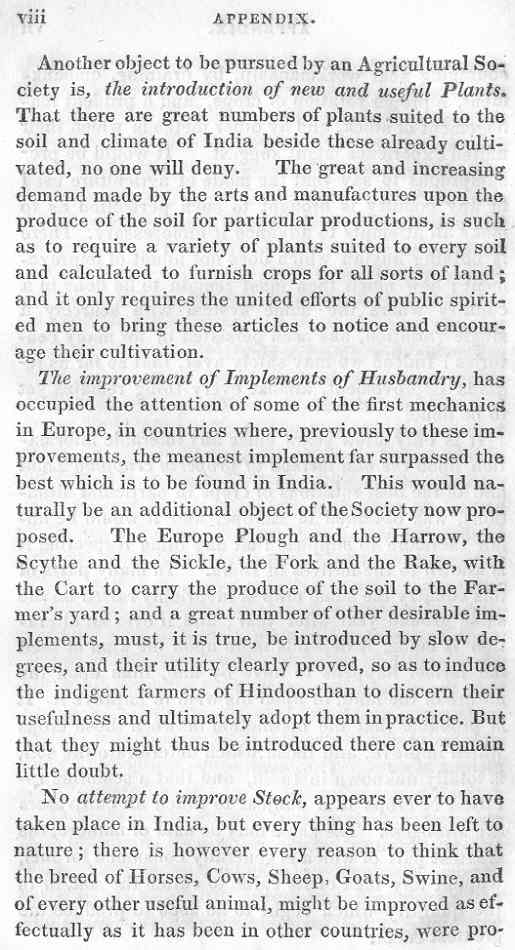
In his address to the Agricultural and Horticultural Society, (200  yrs back,),  Rev. William Carey  made the following observations about Indian livestock “ No attempt to improve Stock, appears ever to have taken place in India, but every thing has been left  to nature; there is however every reason to think that the breed of Horses, Cows, Sheep, Goats, Swine, and every other useful animal, might be improved as effectually as it has been in other countries, were proper  (www.wmcarey.edu/carey/aghort/viii.jpg) means employed to accomplish  the end.  The quantity  of milk  in cows might undoubtedly  be increased, the quality of wool might be improved, a stronger and more useful  race of cattle both for draught and burden might be gradually introduced, and in short every thing might  be expected from persevering attempts to improve those animals which come under the denomination of stock, whether intended for Labour, the Dairy, or of Food. This then  would form a proper object to call forth the exertions of an Agricultural Society.”

The ideas brought to Indian shores by men like Carey over the last 200 years, has inflicted  great damage and suffering to ordinary Indians. The local varieties (nadan) of rice has altogether disappeared from our food basket. There used to more than 3500 species of rice in India.Such rice had taste and also had medicinal /health reinstating values, guaranteeing public health. Maybe the life-style disease ‘diabetics’ would not have assumed epidemic proportions as of  now, in the face of which public health authorities are helpless.


Coming back to livestock issues, the MILK of  indigenous(INDIAN ) breed of cows had medicinal values. And many indigenous breeds are on the verge of extinction. In Kerala, Vechur Cow and Kasargod Dwarf are examples. Pursual of modern ideas in agriculture with an eye on plentiful yield &  profits lead to neglect of  traditional wisdom and practices. Moderns gave weightage to quantity over quality. In  the span of just 200 years, it has become incumbent on us to retrace our steps and pattern our  life as per ancient Indian wisdom. Though Carey may have had good intentions regarding  the welfare of heathens, ultimately all his actions are proving to be injurious to the very people, whom he tried to 'SAVE". (Such are the nuances of KARMA !!)


Kindly go through the following links which are a few(but realiable)  among the numerous ones available on the web. Then all natives of this land will realize what they have lost.

  (42 comments for this article, too many to ready fully)
http://www.thehindu.com/opinion/columns/sainath/article2775282.ece ( 40 comments, came across some negative comments about THE PERSON featured in this news item)


Sunday, February 24, 2013

LAZY AND IDLE HINDOOS- BUT THEY CONTRIBUTED 24.44% of WORLD GDP


Many  well-meaning citizens of this country lamented the loss of two days work, and the consequent productivity loss to the nation, due to the two day general strike called for by the trade unions.

 Similar concerns were expressed by another influential Protestant Missionary, Rev. Claudius Buchanan,(1766-1815), and friend of Rev. William Carey, in 1805 while serving as Vice Provost at Fort William in Kolkatta.  Rev.Buchanan ‘s observations &  intentions towards Hindioos are very clear in his essay titled, “Memoir  of the Expediency of an Ecclesiastical Establishment for British India; both as  a Means of Perpetuating the Christian Religion among our own Countrymen; and as a Foundation for the Ultimate Civilization of Natives.” In the essay , Buchanan sets forth a rationale for an Anglican Establishment in India as follows :- Let us first establish our own religion among ourselves, and our Asiatic subjects will soon benefit by it. When once our national church shall have been confirmed in India,the members of that church will be the best qualified to advise the state as to the means by which, from time to time, the civilization of the natives may be promoted.” (www.wmcarey.edu/carey/buchanan2/est.htm)  In the Contents of the essay listed, Part II deals with Civilization of the natives, in which Chapter V is titled “The numerous holidays of the natives an impediment  to their civilization.”

Excerpts  from Chapter V.
 “1.Another obstacle to the improvement of the natives is the great number of their holidays. These holydays embody their superstition.......

2. In the Hindoo calendar there are upwards of an hundred holydays; and of these government  recognises officially a certain number........During  those Hindoo holydays which are officially  recognised, the public offices are shut up, on account of the festival (as it is termed) of Doora Puja, of  (www.wmcarey.edu/carey/buchanan2/38.jpg) Churruck Puja, of  Rutt Jattra, or of some other.  But great detriment to the public service arising  from the frequent  recurrence of these Saturnalia, govt. Resolved some years ago to reduce the number, which was done accordingly......

3. (Footnote +  on page 39) No people  require fewer days of rest than the Hindoos; for they know nothing  of the corporal exertion and fatigue  from labour, which in other countries  render regular repose  so grateful to the body and spirits. ---In what other country  would it be considered a means of promoting the happiness  of the common people, to grant them so great a portion of the year to spend in idleness and dissipation ? The indulgence operates here as it would in any other country; it encourages extavagence, licentious  habits,  and neglect of business among themselves; and it very seriously impedes the business of the state, and deranges commercial negotiation.” (www.wmcarey.edu/carey/buchanan2/39.jpg)

Till 1700, or till the 1700’s, India had contributed 24.44% of the World GDP. In the same period, Protestant Britain’s share is only 2.88%. (See the  table above). The majority ‘idle’ and ‘licentious’ Hindoos, and the minority ‘Musalmans’ between themselves were able to produce 24.44%  of World GDP. And the gentlemen from England had landed here to buy , the goods and other supplies produced by this’uncivilized natives’.

Surely The Hindu Approach Towards Work (KARMA)  WAS Optimal, and that is the prescription for the modern world to save itself from disaster!!!!

Saturday, February 23, 2013

PRELUDE TO OPENING OF PANDORA’s BOX in the midst of INDIAN FARMERS and in their FIELDS


Rev.William Carey,(1761-1834) , Father of Modern Missions, had given an extensive picture “On the State of Agriculture, in the District of Dina’jpur”. This was published by the ASIATIC SOCIETY in 1808. (www.wmcarey.edu/carey/asiatic-researches/dinajpur/dinajpur.pdf)

Carey  is  the  founder of the Agricultural and Horticultural  Society of India. This  Society, the first of its kind in India was founded in 1820. In India, a University in Meghalaya is named after him. In addition to this there are nine other institutions in the world named after him. Lot of encomiums are heaped on  this ‘English gentleman’, at home(India)  and abroad.

Carey had meticulously described about the agricultural practices in Bengal. Which includes inter-cropping (see page 10, middle of para 3) & crop rotation,(see page 16, para 2), though later in his Address to the Agricultural and Horticultural society, he  asserts that Indian farmers never knew of crop rotation.

On two counts this  reportage from Carey, should engage our special attention.

(1) In this meticulous report, which even includes some detailed sketches towards the end, PESTS or PEST ATTACKS on Crops are NOT mentioned. It can mean that,  traditional  agricultural practices in India almost PREVENTED   the manifestation and multiplication of pests. Only after the introduction of hybrid varieties, we became aware of intensified pest attacks.

(2) The working style or the work ethic(KARMA) and worldview  of Indian farmers is looked down upon   by Carey.  He reports “At present   the poverty, prejudices, and indolence of the natives strongly operate against improvements in agriculture. Could an adequate remedy  be found for these evils, many other things might be cultivated with great advantage.” (p.21, para 2) Carey’s stinging observation about Indian farmers and their  LOW output (due to laziness) is at variance from the figures compiled from this period, which proves Carey to be wrong in his judgement.

Two work ethics mutually opposed to each other are operating here -INDIAN  vis-a –vis the PROTESTANT WORK ETHIC.  Figures published  after Carey’s death , in 1878 shows that contrasted to 31 serious famines in 120 years of British rule , there were only seventeen recorded famines in the entire previous two millennia (2000 yrs).(Source : C. Walford, “The Famines of the World: Past and Present,” Journal  of the Statistical Society 41:13 (1878) pp 434-42). Thus Indian Work Ethic was replaced by the Protestant One, which had caused/and is causing undue sufferings for all !!!!

Excessive meddling with nature and trying to control it , for satiating the wants & greed had (re-) opened the Pandora’s box, and pests are one of the evils coming out of it. The West does not know the nuances of KARMA !!!

Friday, February 22, 2013

RICE AS MEDICINE


The difference between the traditional and the other varieties was infinite, he said. The traditional varieties were not only tasty but also contained medicinal properties, he added.

Mr. Nammalwar contended that the dependence on the chemical fertilizers had resulted in the microbial population getting reduced. The Tamil Nadu Agricultural University had found that the traditional varieties had better protein content than the other varieties. For the traditional varieties, there was no necessity to sink deep borewells and this ultimately reduced power consumption also, he pointed out.


The Hindu : NATIONAL / TAMIL NADU : Traditional varieties can tolerate drought: scientist

Please note that there is a sentence in this reprot which says that agriculture is "location-specific."

TRADITIONAL FARMING TECHNIQUES GAINING GROUND

“The reason is that all of them are consistently using  + Panchagavya for their crops. Panchagavya can be easily prepared by the farmer. Cow dung and urine are the main inputs required for this. We have trained hundreds of farmers in this area over the last several years in making it for their own use,” he said.

The Hindu : Today's Paper / NATIONAL : A panacea for farmers of water-starved Tirunelveli

END OF GREEN REVOLUTION - END OF SCIENCE !?


“Though, during the start of the green revolution fertilizers and pesticides led to high yields in hybrid crops, later on it led to serious issues like development of insect resistant, resurgence and residual problems.

“Natural and non pesticidal methods for controlling pests have been in place since time immemorial. But sadly the present generation of farmers has either forgotten their efficiency or are not prepared to accept them,” says Dr. Alagesan.


The Hindu : FEATURES / SCI-TECH & AGRI : Fermented castor solution traps pests of sugarcane, groundnut

This is another example of Tradition vs Modernity (Tyranny)

TRADITION vis-a-vis MODERNITY - RICE CULTIVATION


“Now, many farmers in the district are showing interest in traditional rice cultivation, thanks to the various afflictions suffered by the hybrid varieties recently. We are giving them seeds from our gene bank.”

The Hindu : FEATURES / SUNDAY MAGAZINE : The rice is right

These links to reportage in The Hindu Newspaper are necessary to the continuity of this blog.